More Than a Letterbox Magnet:
Why Your Trade Business
Needs a Website
If most of your work comes through word-of-mouth, you might wonder why you need a website at all.
For years, letterbox drops and fridge magnets have been a staple of local trade marketing. They’re simple, affordable and practical: your name and number land in someone’s home, ready to be found when the tap starts leaking, the fence needs fixing or the next renovation comes around.
But these days, being remembered is only part of the job.
Increasingly, people will search your business online before they pick up the phone. They’ll look at your work, check your reviews, find out what services you offer and decide whether you look like the right person for the job.
Your van gets you noticed.
Your reputation gets you recommended.
Your website helps people decide to call.
For a small trade business, a website can become a valuable part of the business you’ve already built - working alongside word-of-mouth, Google, reviews, social media and local advertising to help turn recognition into enquiries.
You don’t need to replace what already works
If your business has grown through referrals, repeat customers and local recommendations, that’s something to be proud of.
You may already have a steady stream of work. You might have your logo on the van, a stack of letterbox magnets doing the rounds, a Facebook page and plenty of customers who are happy to recommend you.
We’re not suggesting you throw any of that away.
The best website doesn’t replace the marketing that’s already working for your business. It makes it work harder.
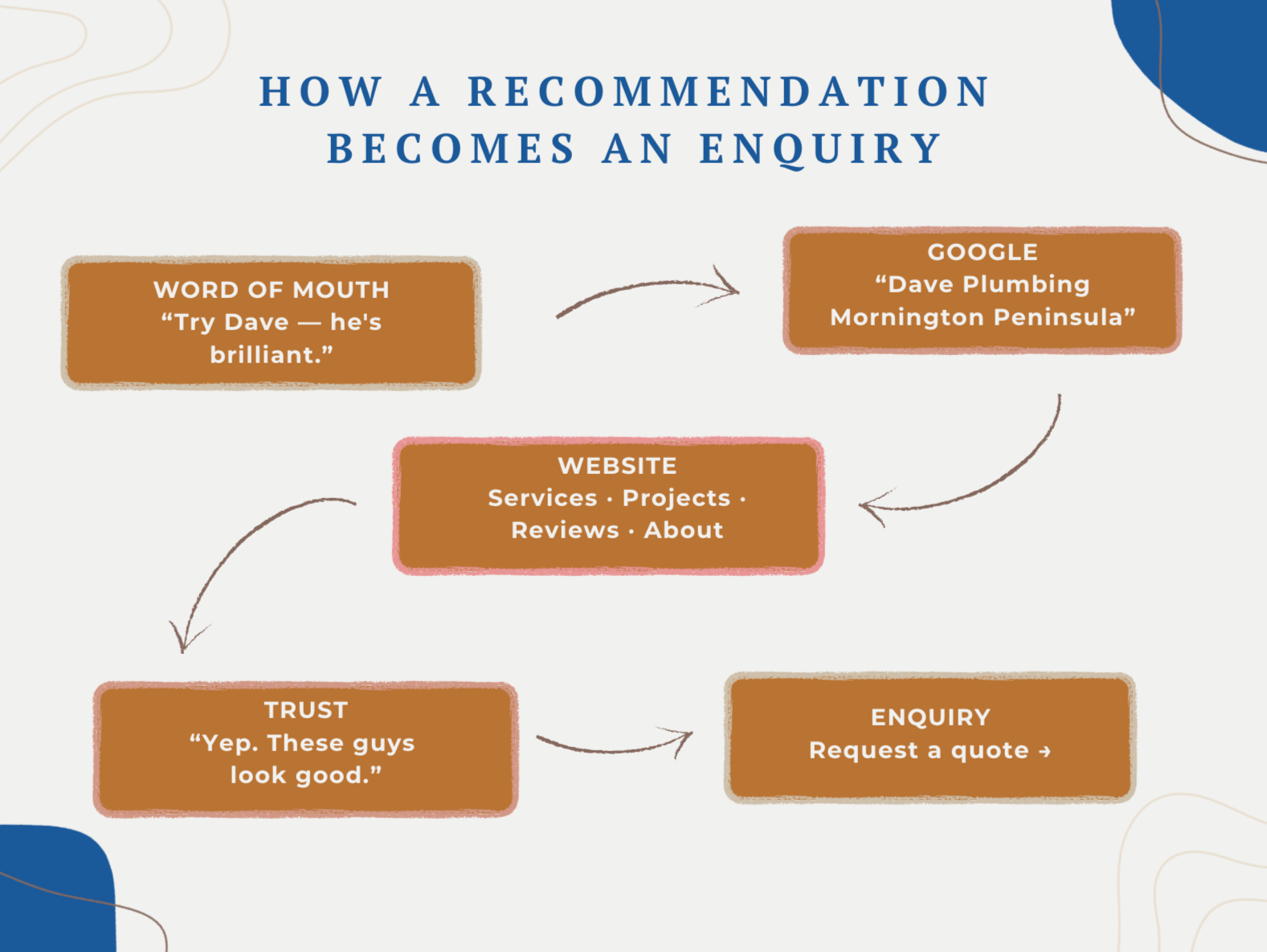
Think about what happens when someone gets your name from a neighbour.
“Try Dave. He’s brilliant. He did our kitchen.”
That’s a great recommendation.
But then they might Google you.
And that’s the moment your website has a job to do.
It can show them the kind of work you do, the areas you service, examples of previous projects, what your customers say about you and, importantly, give them confidence that you’re the right person to contact.
A recommendation can get you searched. Your website can help get you chosen.
Your next customer may already be searching
A lot of trade businesses don’t need to convince people that they need a plumber, electrician, carpenter, builder, landscaper or painter.
The need already exists.
Someone is renovating. Their switchboard needs attention. They’re planning a new deck. Their garden needs a serious overhaul.
They’re looking for someone who can help - often in their local area.
That might mean searching for plumber Mornington Peninsula, electrician Mount Eliza, carpenter Mornington, landscaper Balnarring or another combination of service and location.
If your business doesn’t have a website, you’ve got very little opportunity to show up beyond your Google Business Profile or directory listings.
A well-structured website gives Google - and potential customers - much more information about what you do, where you work and the services you offer.
The goal isn’t to be found for everything. It’s to be found for the work you actually want.

Give people a reason to choose you
Two businesses might offer exactly the same service.
Both are qualified. Both have years of experience. Both provide quotes.
So how does a customer decide? Often, it’s about confidence.
Your website gives you an opportunity to show what makes your business different - without having to explain it from scratch every time someone calls.
Whether you’ve been in the trade for 20 years, specialise in older homes or coastal properties across the Mornington Peninsula or are known as a small, hands-on team where customers deal directly with the person doing the work.
Whatever your point of difference is… Those things matter.
And they’re exactly the things that can get lost when your business is reduced to a phone number on a van or a recommendation passed between neighbours.
Your website gives your reputation somewhere to live.
Show people what you’re really good at
For many trades, the work itself is your strongest marketing tool.
A beautifully finished deck.
A thoughtful renovation.
A carefully restored period home.
A transformed garden.
A quality electrical fit-out.
Your customers can see the result in person.
But what about the next customer?
A website gives you somewhere to show them.
A project gallery can demonstrate your experience, attention to detail and the types of jobs you’re comfortable taking on.
It can also help you attract the right work.
A carpenter who builds custom decks doesn’t necessarily want to be found only for small repair jobs.
A landscaper specialising in garden design and construction may want to attract larger residential projects.
An electrician may offer everything from general electrical work to switchboard upgrades, EV chargers or lighting.
Your website can give each important service the space it deserves - and create opportunities to be found for specific services in the areas you work.
Instead of simply saying:
“We do carpentry.”
You can show people:
Decking. Renovations. Extensions. Custom timber work. Outdoor structures.
That distinction can make a big difference to the kind of enquiry that comes through.
A Facebook page isn’t the same as a website
Social media can be useful for a trade business.
It’s a great place to share a finished project, show what’s happening on site or stay visible to people who already know you.
But a Facebook or Instagram page isn’t a substitute for having your own website.
Your website is your digital home.
You control what appears there, how your business is presented and what information a potential customer sees first.
You can structure it around the things that matter to your customers:
· Your services
· Your projects
· Your experience
· Your team
· Testimonials and reviews
· Areas you service
· Frequently asked questions
· Your approach
· Your contact details
· And a clear way to request a quote or make an enquiry.
Social media can support all of this.
Your website brings it together.
Local SEO starts with being clear about where you work
If you’re a local trade business, being good at what you do isn’t enough if potential customers can’t find you.
That’s where local SEO comes in.
Your website can help establish the places and services your business is genuinely relevant to — whether that’s the Mornington Peninsula as a whole or particular areas such as Mornington, Mount Eliza, Mount Martha, Balnarring, Somers, Sorrento, Rosebud or surrounding suburbs.
That doesn’t mean filling every page with a list of suburbs.
Good local SEO is much more useful than that.
It’s about creating clear, helpful pages that tell both customers and search engines:
What you do.
Where you do it.
Who you do it for.
And why you’re worth contacting.
A dedicated service page for residential landscaping, for example, is far more useful than simply putting “Landscaping” in a menu.
And a page explaining the areas you service gives potential customers confidence that you’re actually local to them.
Local SEO isn’t about trying to be everywhere. It’s about being visible where the right customers are looking.

Your Google presence and your website should work together
Your website is only one part of your online presence.
For a local trade business, your Google Business Profile matters too. It helps people find your business, see your service area, read reviews, look at photographs and contact you.
Your website gives that customer somewhere to go next.
Think of the two as working together:
Google helps people find you.
Your website helps them understand you.
Then there are your reviews.
A strong recommendation from a friend has always been powerful. Online reviews are another form of social proof — particularly when someone is comparing businesses they don’t know personally.
The strongest online presence isn’t necessarily the business with the most followers or the flashiest website.
It’s the business where all the pieces make sense.
Google → Website → Projects → Reviews → Enquiry
Become the expert before you’ve even spoken to the customer
Your customers have questions.
And chances are, you’ve answered many of the same ones hundreds of times.
Those questions can become useful website content - particularly when they’re specific to the services you provide and the customers you want to attract.
For example, a local builder could create useful content around renovating older homes on the Mornington Peninsula. A landscaper might answer questions about designing gardens for coastal conditions. A carpenter could share advice about choosing timber for an outdoor project in a coastal environment.
This kind of content can demonstrate knowledge, build trust and create additional opportunities to appear in relevant searches.
And there’s no need to put everything on your main website page.
The bigger questions can become their own articles - creating a useful library of content that continues to build your online presence over time.
Build something that keeps working
A letterbox drop has a particular moment in time.
A van drives past.
A customer sees your signage.
Someone recommends you to a neighbour.
These are all useful ways to build awareness.
A website is different.
Once it’s built, it remains there.
Someone can find it on a Tuesday morning when they’re planning a renovation, or months after a friend first mentioned your business.
And every time you add a new project, service, testimonial or useful piece of information, you’re adding to that resource.
That’s why we see a website as a long-term marketing asset, rather than simply another advertising expense.
It requires an initial investment, and good websites still need a domain, hosting, maintenance and, if you want to keep developing your visibility, ongoing content or SEO work.
But unlike a printed flyer, the website isn’t finished once the campaign is over.
It keeps giving people somewhere to find you, learn about you and make contact.
A good website can help your business grow
Your website doesn’t only need to be about getting the next small residential job.
As your business grows, what you need from your marketing can grow with it.
You might want to take on larger projects, work with architects and designers, expand into a new service area or attract another experienced team member or apprentice.
A professional website gives people outside your existing customer network a better understanding of who you are and what your business is capable of.
It can show the scale and quality of your work.
It can communicate how you operate.
It can introduce your team and values.
Your website should reflect where your business is going - not just where it started.
Don’t replace what works. Make it work harder.
There’s a temptation to think about marketing as an either/or decision.
Website or letterbox drops.
Google or word-of-mouth.
Facebook or SEO.
But that’s not really how a local trade business works.
The different pieces can support one another.
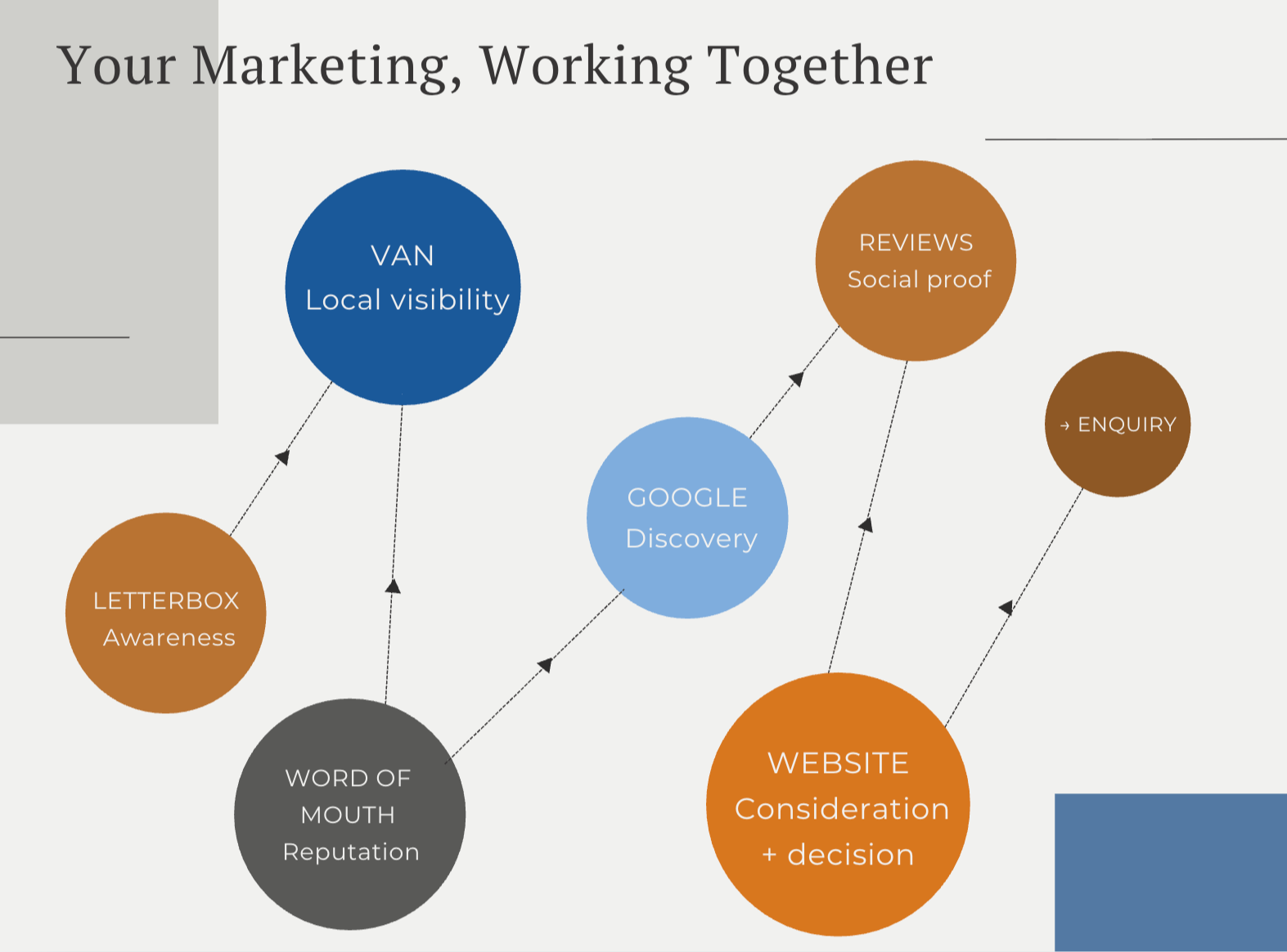
Your van builds awareness.
Your local advertising puts your name in front of people.
Your customers recommend you.
Google helps people find you.
Your reviews give them social proof.
Your website gives them the information they need to make a decision.
And a clear call to action makes it easy to take the next step.
Think of it as a journey:
SEE YOU → HEAR ABOUT YOU → SEARCH FOR YOU → CHECK YOU OUT → TRUST YOU → CONTACT YOU
Your website sits right in the middle of that journey.
That’s why it doesn’t need to replace your other marketing.
It needs to make the rest of it more valuable.
So, do you actually need a website?
If your business is already busy, perhaps the answer isn’t “I need a website to get more work.”
Perhaps it’s:
“I need a website so that when people are looking for me, they see the business I’ve actually built.”
Because if someone recommends you, searches for you and lands on a neglected Facebook page, an outdated directory listing or nothing at all, you’ve left part of the decision-making process to chance.
But if they find a professional, straightforward website that shows your work, explains your services and demonstrates that other customers trust you, you’ve given them another reason to pick up the phone.
It shouldn’t try to turn you into an online marketer.
It shouldn’t replace the reputation you’ve spent years building.
It should make that reputation easier to see.
Your business already has a reputation. Your website should show it.
At 6am Creative, we create straightforward, professional websites for local trades and small businesses across the Mornington Peninsula.
We don’t believe every business needs a complicated website.
We believe it needs the right website — one that reflects the business behind it, makes your services easy to understand, showcases the work you’re proud of and makes it simple for the right customers to get in touch.
If you’re ready to give your trade business a stronger online presence, take a look at our Small Business Website Design services or get in touch to talk about what your business actually needs.
Your van gets you noticed.
Your reputation gets you recommended.
Your website helps people decide to call.
If you want to chat about website designs for your trade or small business, get in touch.